Solar-Powered Boiler Systems Are Transforming Home Heating (Here’s What You Need to Know)
Solar-powered boiler systems combine traditional heating infrastructure with photovoltaic panels to dramatically cut energy bills, sometimes by 50% or more, while reducing your carbon footprint. If you’re a homeowner or property manager weighing the switch from conventional gas heating, you’re looking at an initial investment of £5,000 to £12,000 for a complete residential system in 2026, with most installations paying for themselves within 7 to 12 years through energy savings and government incentives. Before committing to any installation, consult with an Electrician Nottingham professional or gas engineer to assess your property’s specific requirements.
Here’s what makes these systems work: solar panels generate electricity that powers an electric boiler or heat pump, or they heat water directly through thermal collectors. You’re not abandoning your existing heating setup entirely. Instead, you’re creating a hybrid system where solar energy handles the bulk of your heating load during sunny periods, and your traditional boiler kicks in only when needed. This flexibility is exactly why proper professional assessment of your property is essential.
The technology has matured significantly. Modern solar thermal collectors achieve efficiency rates above 70%, even on overcast days, while photovoltaic systems paired with battery storage let you use solar energy around the clock. That’s one of the compelling reasons for solar adoption across the UK, where energy independence matters more than ever.
This guide walks you through everything: how the technology actually functions in real homes, what you’ll spend (and save), how to choose components that match your property’s needs, step-by-step installation guidance, and the maintenance schedule that keeps everything running smoothly. We’ve included testimonials from homeowners who’ve made the switch, so you’ll see exactly what to expect from day one through year ten and beyond.
How Solar-Powered Boiler Systems Actually Work
Solar Thermal Collectors: Your Heat Harvesting Engine
Solar collectors do the heavy lifting in any solar boiler setup. Think of them as purpose-built heat engines sitting on your roof, soaking up sunshine and turning it into usable warmth for your home. They’re the front line of solar thermal energy conversion.
You’ll encounter two main designs: flat-plate and evacuated-tube collectors. Flat-plate models look like dark glass panels. Inside, a copper or aluminum absorber plate sits beneath glazing, with fluid-filled tubes running through it. When sunlight hits the dark surface, it heats the fluid flowing through those tubes, simple, reliable, and cost-effective. They work brilliantly in moderate climates where freezing isn’t a constant worry.
Evacuated-tube collectors take a different approach. Each tube contains a glass cylinder with a vacuum between layers, similar to a thermos flask. That vacuum acts as insulation, trapping heat even when outside temperatures drop. The absorber inside each tube heats transfer fluid or uses a heat pipe to move warmth into a manifold. They’re pricier upfront but excel in cold, cloudy conditions and capture heat at steeper angles throughout the day.
Both types channel heated fluid to your storage tank, where that captured energy waits until your home needs it. The choice between them depends on your climate, budget, and how much roof space you can dedicate to harvesting the sun’s power.
The Integration With Traditional Boiler Systems
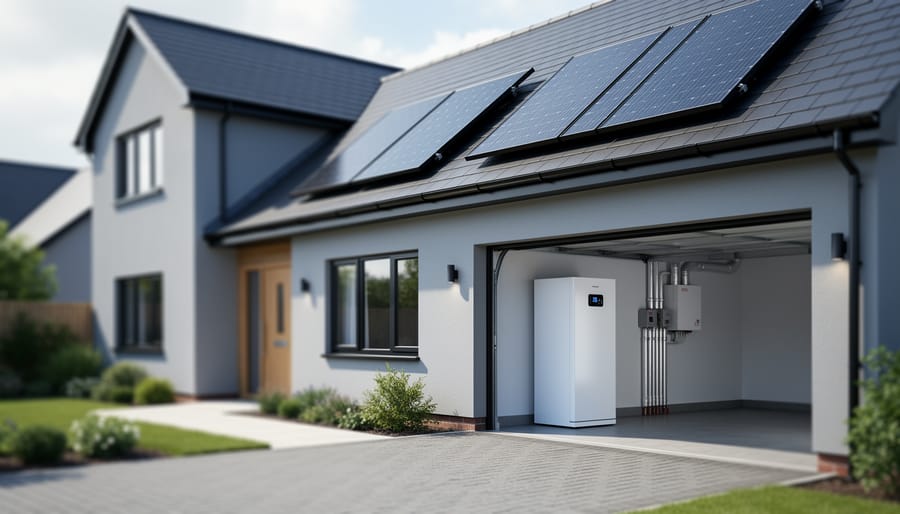
Solar boilers aren’t designed to strand you without heat on overcast days or during winter nights. Instead, they work in tandem with your existing gas or electric boiler, creating a hybrid system that draws from solar energy first and seamlessly switches to conventional fuel when needed.
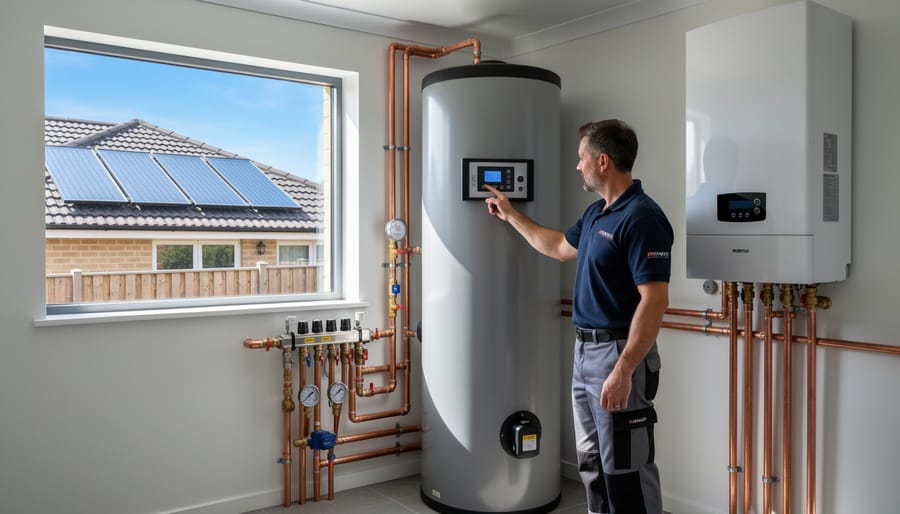
Here’s the typical setup: solar collectors on your roof heat a fluid that flows to an insulated storage tank. Your traditional boiler connects to this same tank. When the sun provides enough heat, your gas boiler stays off, you’re using free solar energy for hot water and heating. On cloudy days or when demand exceeds what solar can provide, sensors trigger your conventional boiler to kick in and top up the temperature.
Most homeowners set a threshold temperature. If the solar-heated water reaches, say, 55°C, the gas boiler never fires. Drop below that? The boiler supplements just enough to meet your needs. This dynamic pairing means you’re never left cold, yet you’re maximizing solar gain whenever possible.
Some systems also include electric immersion heaters as a secondary backup, giving you three layers of heating security. The beauty is flexibility: during summer, many households run entirely on solar for weeks at a time. In winter, solar pre-heats the water, so even when your gas boiler runs, it works less and burns less fuel. You’re not replacing reliability, you’re enhancing it with renewable energy that reduces both your bills and carbon output.
Real Cost Savings: What Homeowners Are Experiencing in 2026
Installation Investment and Return Timeline
Installing a solar-powered boiler system for your home typically costs between $8,000 and $15,000 in 2026, depending on system size and your existing heating setup. That’s a significant upfront investment, but here’s where the math gets interesting.
Most homeowners see monthly energy bill reductions of 50-70% on their heating costs. If you’re currently spending $150 monthly on gas heating during winter months, that’s $900-$1,050 in annual savings. Factor in the federal solar tax credit (currently 30% of installation costs) and state-level rebates, and your effective investment drops considerably. A $12,000 system becomes $8,400 after federal credits alone.
The typical payback period runs 7-12 years, but this varies based on your climate, current energy costs, and heating demands. Northern homeowners with high winter heating bills recover costs faster. The ROI calculation becomes even more attractive when you consider that quality solar boiler systems last 25-30 years with proper maintenance.
After payback, you’re looking at 15-20 years of nearly free heating. One Massachusetts homeowner reported saving $14,000 over ten years, with their system projected to deliver $28,000 in total savings over its lifetime. That’s the difference between viewing this as an expense versus recognizing it as an income-generating home improvement that pays dividends for decades.
2026 Incentives and Rebates You Can Claim
The federal solar investment tax credit now covers 30% of your total solar boiler installation costs through 2032, offering substantial upfront savings that can amount to thousands of dollars on a typical residential system. Many homeowners find combining these federal rebates and incentives with state programs creates an even more compelling financial case. States like California, New York, and Massachusetts offer additional rebates ranging from $500 to $3,000, while property tax exemptions in over 30 states mean your home’s increased value won’t raise your tax bill. Local utility companies frequently provide performance-based incentives that pay you for the clean energy your system produces. The Database of State Incentives for Renewables and Efficiency provides a searchable tool to identify every program available in your specific location. Act quickly though, many state and utility programs operate on limited annual budgets that can run out before year-end.
Real Homeowner Testimonial: The Johnson Family’s Journey
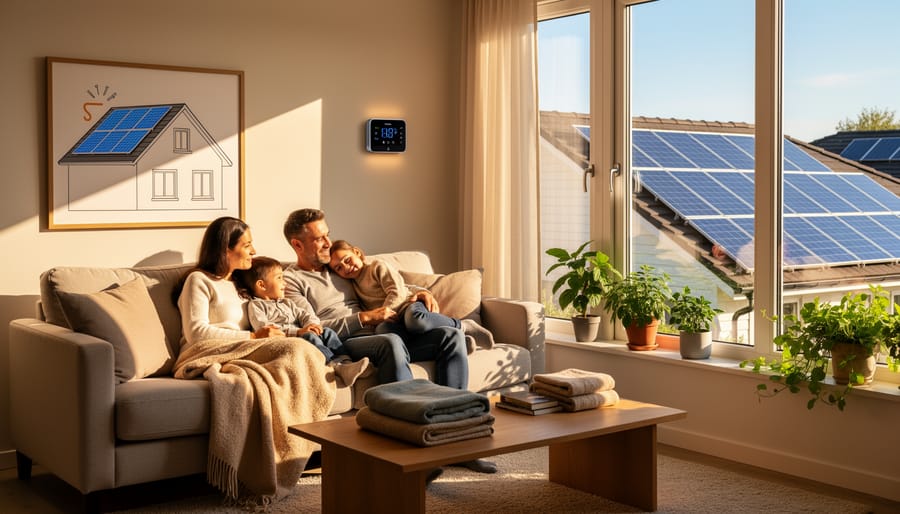
We switched to a solar boiler system in March 2025, and honestly, it’s been one of our best home investments. Our old gas boiler was costing us around $240 monthly during winter. After installation, our heating bills dropped to about $60, even during the coldest months.
The decision wasn’t easy. The $12,000 upfront cost felt steep, but with the federal tax credit covering 30%, we paid closer to $8,400. We’re now saving roughly $2,000 yearly, putting us on track to break even in just over four years.
What surprised us most? How quietly it runs and how our home stays consistently warm. We haven’t touched the backup gas system once this past winter.
Choosing the Right Solar Boiler System for Your Home
System Sizing: Getting the Capacity Right
Getting your solar boiler system sized correctly is the difference between enjoying comfortable, efficient heating and either overspending on unnecessary capacity or shivering through cold evenings. Most homeowners need a system that provides 40-70% of their annual hot water and heating needs, with the exact percentage depending on climate and usage patterns.
Start with your household’s daily hot water consumption. A typical person uses 20-40 gallons of hot water daily, so a family of four needs approximately 80-160 gallons. Multiply your daily consumption by 0.6 (accounting for solar heating efficiency) to estimate the minimum collector area, for instance, 100 gallons daily requires roughly 60 square feet of collector surface.
Your geographic location dramatically affects system sizing. In sunny Arizona, 40 square feet of collectors might meet 70% of a household’s needs, while the same family in cloudy Seattle would need 80 square feet to achieve 50% coverage. Check your area’s average daily solar radiation (measured in kWh/m²/day), values above 5 indicate excellent solar potential, while areas below 3 require larger systems or realistic expectations about supplemental heating needs.
Factor in your home’s existing heating demand by reviewing last year’s energy bills. A qualified installer can translate your annual BTU consumption into required collector area, typically calculating 15-25 square feet per person for domestic hot water and an additional 200-400 square feet for space heating in moderate climates. Avoiding common solar pitfalls during this planning phase prevents costly oversizing or undersizing mistakes that compromise long-term satisfaction.
Active vs. Passive Solar Boiler Systems
The choice between active and passive solar boiler systems fundamentally comes down to how heat moves from your collectors to your storage tank. Active systems use electric pumps and electronic controls to circulate heat transfer fluid through the collectors. A controller monitors temperature sensors and activates the pump when collectors are hotter than the storage tank, ensuring efficient heat capture. These systems offer precise control and work well even when collectors must be mounted below the storage tank.
Passive systems rely on thermosiphon principles, hot water naturally rises while cold water sinks. As collectors heat the fluid, it rises into a storage tank positioned above the collectors, creating continuous circulation without pumps or electricity. This elegant simplicity makes passive systems extremely reliable in sunny climates.
- Work with any collector and tank placement configuration
- Precise temperature control optimizes heat capture
- Better performance in variable or cloudy conditions
- Can serve larger households with greater storage capacity
- Higher installation cost due to pumps and controllers
- Require electricity to operate, reducing net savings
- More components mean more potential failure points
- Need periodic maintenance of pumps and sensors
- No electricity needed, maximizing energy independence
- Extremely reliable with minimal moving parts
- Lower installation and maintenance costs
- Silent operation with no pump noise
- Require tank placement above collectors, limiting design options
- Less efficient in partly cloudy conditions
- Slower circulation can mean reduced heat transfer
- Generally suited to smaller heating loads
Choose active systems when your roof structure won’t accommodate a tank above collectors, you need to heat a larger home, or you live somewhere with frequent cloud cover. Passive systems shine in consistently sunny climates with smaller heating needs and roof configurations that allow elevated tank placement. Your site conditions and household size will make the right choice obvious.
What to Look for in Quality Components
When you’re evaluating solar boiler components, start with solar collectors that carry OG-100 or SRCC certification, these stamps confirm the unit meets rigorous performance and durability standards. Look for absorber coatings with selectivity ratings above 0.95, which means they convert sunlight to heat efficiently while minimizing losses.
Storage tanks should feature thick insulation (at least 4 inches of polyurethane foam) and a glass-lined or stainless steel interior to prevent corrosion. Cheaper enameled tanks often fail within five years, while quality stainless models last 20-plus years.
For control systems, prioritize differential controllers with precise temperature sensors (accurate within 1°C) and freeze protection algorithms. These smart controls prevent overheating in summer and system damage during winter freezes. Check warranty terms too, reputable manufacturers back collectors for 10-15 years and tanks for 5-10 years, signaling confidence in component longevity.
Step-by-Step: Installing Your Solar Boiler System
Pre-Installation: Site Assessment and Preparation
Before mounting solar collectors, assess your roof’s condition and load-bearing capacity. Most residential roofs built to modern codes handle the additional weight (typically 2-3 pounds per square foot for collectors plus mounting hardware), but older structures may need reinforcement. Walk your roof to check for damaged shingles, rot, or sagging, address these issues before installation to avoid costly repairs later.
Examine sun exposure throughout the day. South-facing roof sections receive optimal sunlight in the Northern Hemisphere, while clear eastern or western exposures work adequately. Shade from trees, chimneys, or neighboring buildings reduces system efficiency significantly. Use a solar pathfinder tool or smartphone app to map shade patterns across seasons.
Contact your local building department about permit requirements. Most jurisdictions require structural and electrical permits for solar installations. Homeowners associations may have aesthetic guidelines affecting collector placement. Submit permit applications 4-6 weeks before your planned installation date, delays are common.
Measure your available roof space carefully. Standard flat-plate collectors typically measure 4×8 feet. Calculate whether your unshaded area accommodates the collector array size determined during your system sizing phase.
Mounting Solar Collectors Safely and Effectively
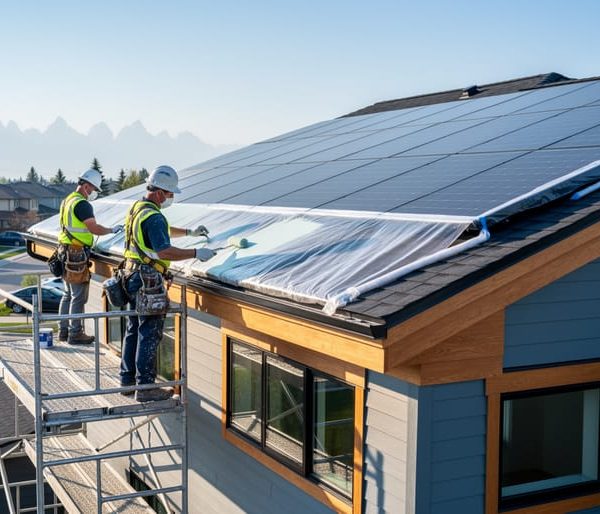
Securing solar collectors to your roof requires attention to both structural integrity and optimal positioning. Start by locating roof rafters using a stud finder, marking their positions clearly. Mount the collector frames directly into these rafters, never just into sheathing, using 3/8-inch lag bolts with washers. Space mounting brackets no more than four feet apart to handle wind loads and snow weight.
For angle and orientation, aim your collectors due south (in the Northern Hemisphere) and tilt them at an angle roughly equal to your latitude plus 15 degrees for winter heating emphasis. A 45-degree tilt works well for most of the continental United States. Use an angle finder app on your smartphone to verify the mounting rail pitch before securing collectors.
Weatherproofing is critical. Apply high-quality roofing sealant generously around each penetration point where bolts pass through shingles. Install flashing boots, the same type used for plumbing vents, over each mounting foot to channel water away. After securing the collectors, run a bead of UV-resistant silicone around the frame perimeter where it meets the roof.
Check that collectors sit level from side to side using a spirit level; an uneven installation can trap air and reduce circulation efficiency. Finally, attach the collectors to the mounting rails with the provided clamps, tightening bolts in a star pattern to distribute pressure evenly and prevent panel warping.
Connecting to Your Existing Heating System
Integrating solar collectors with your existing heating infrastructure requires careful attention to piping, controls, and backup coordination. The solar loop connects to a thermal storage tank, typically a dual-coil model, that sits between your collectors and conventional boiler. Hot fluid from the collectors enters the tank’s heat exchanger, transferring warmth to potable water stored inside.
Install a three-way diverting valve that automatically routes heated water from storage to your radiators or underfloor heating when temperatures meet demand. When solar-heated water drops below your thermostat setting, the valve switches seamlessly to your gas or electric boiler. This ensures uninterrupted comfort during cloudy periods without manual intervention.
Critical: Install a differential controller that monitors temperatures at the collector and storage tank. It activates the circulation pump only when collectors are warmer than stored water, preventing backward heat flow at night. Most systems require tempering valves too, mixing cold water if solar-heated supply exceeds safe domestic temperatures.
Professional plumbers recommend insulating all connecting pipes with foam sleeves rated for your climate. Heat loss between components can slash efficiency by 15-20% in poorly insulated runs.
System Testing and Optimization
Once your collectors are connected, it’s time to bring your system to life. Start by slowly filling the circuit with heat transfer fluid, watching for leaks at every joint and connection. As fluid enters, air pockets will form, these are efficiency killers. Open the air bleed valves at high points in the piping, letting trapped air escape until only fluid flows out.
Next, run the circulation pump and check that fluid moves smoothly through the entire loop. Your temperature gauges should show gradual warming when collectors face the sun. Set your controller’s differential temperature, typically 10-15°F between collectors and storage tank triggers pump activation. Too narrow and the pump cycles constantly; too wide and you miss collection opportunities.
Monitor the system through several sunny days, noting how quickly your tank reaches target temperature. If heating seems sluggish, verify pump speed settings and recheck for remaining air pockets. Most systems hit peak efficiency after a week of operation as fluid fully circulates and any minor air works itself out naturally.
Maintenance That Keeps Your System Running for Decades
Seasonal Maintenance Tasks
Keeping your solar boiler system in top shape requires attention at key times throughout the year. Before winter arrives, inspect all collector surfaces for debris and clean them thoroughly to maximize sunlight absorption during shorter days. Check antifreeze levels in your solar loop, this fluid prevents freezing damage and should be tested annually. Examine insulation on exposed pipes and repair any worn sections to maintain winter performance.
During summer peaks, monitor system pressure as heat expansion can stress components. Verify that your relief valve operates correctly and that excess heat dissipation mechanisms work properly. Clean collectors again after spring pollen season.
Year-round, inspect mounting hardware for corrosion or loosening, particularly after storms. Check pump operation monthly by listening for unusual noises. Keep an eye on your system’s temperature readings, sudden drops signal potential issues. Most homeowners spend just two hours per season on these preventive tasks, a small investment that protects your heating system for decades.
Troubleshooting Common Issues
Air locks are among the most frequent culprits when your solar boiler isn’t performing as expected. You’ll notice them when radiators heat unevenly or the system makes gurgling noises. To release trapped air, locate the bleed valves on your collectors and radiators, then open them slowly with a radiator key while the pump runs. Clear fluid flowing without bubbles signals success.
Pump failures often announce themselves through unusual silence, no humming sound when the system should be circulating. Check your pump’s power supply first, then inspect for seized components by trying to turn the shaft manually (power off, naturally). Most modern pumps have a reset button that solves temporary overload issues. If the pump’s hot to the touch or won’t budge, replacement is likely needed.
Reduced heat output during sunny periods usually points to glycol degradation in the heat transfer fluid. This protective antifreeze breaks down over time, especially if your system’s overheated repeatedly. Testing strips reveal fluid condition, and complete fluid replacement typically restores performance. You’ll see this issue manifest as collectors getting scorching hot while storage tanks stay lukewarm.
Pressure drops signal leaks somewhere in the closed loop. Your pressure gauge should read between 1.5 and 2 bar when cold. Falling pressure means checking visible pipe joints, collector connections, and the expansion vessel. Tighten compression fittings carefully and inspect flexible hoses for wear. Persistent pressure loss despite no visible leaks suggests calling a qualified technician to pressure-test the system properly.
Environmental Impact: The Numbers That Matter
Switching from a traditional gas boiler to a solar-powered system delivers measurable environmental benefits that extend far beyond your household. A typical home in 2026 using a conventional gas boiler emits approximately 2.4 to 3.1 metric tons of carbon dioxide annually just for heating and hot water. By contrast, a properly sized solar boiler system can reduce those emissions by 60 to 80 percent, depending on your climate zone and backup heating requirements.
The numbers become even more striking when you look at the lifetime impact. Over a 25-year operational lifespan, the conservative estimate for quality solar thermal systems, a single household can prevent 45 to 60 metric tons of CO2 from entering the atmosphere. That’s equivalent to taking a car off the road for nearly 12 years or planting roughly 2,700 trees.
Beyond carbon reduction, solar boilers significantly decrease other harmful pollutants. Natural gas combustion releases nitrogen oxides, particulate matter, and methane, a greenhouse gas 80 times more potent than CO2 over a 20-year period. Solar thermal systems eliminate these emissions entirely during operation, improving both global air quality and the immediate environment around your home.
Water consumption tells another compelling story. Gas extraction and power plant cooling for conventional heating systems require substantial water resources. Solar boilers operate in a closed-loop system requiring minimal water beyond the initial fill, reducing your indirect water footprint by an estimated 1,200 to 1,800 gallons annually.
These aren’t abstract environmental wins. Every solar boiler installation in 2026 represents a tangible step toward cleaner air, reduced fossil fuel dependency, and a more stable climate for future generations.
Solar-powered boiler systems represent more than just another home improvement option. They’re a meaningful step toward energy independence and a cleaner future. Throughout this guide, you’ve seen how the technology works, what it costs, and how real families are already reaping the rewards in 2026.
The financial case speaks for itself. Between direct energy savings, available incentives, and rising conventional fuel costs, most homeowners recover their investment within seven to ten years. After that, you’re looking at decades of virtually free heating. That’s money back in your pocket, year after year.
But the benefits extend beyond your bank account. Every day your solar boiler operates, you’re reducing carbon emissions that would otherwise contribute to climate change. You’re demonstrating to your neighbors and community that sustainable living isn’t just theoretical, it’s practical, achievable, and rewarding.
The transition might feel daunting at first. New technology always does. Yet thousands of homeowners have already made the switch successfully, many handling significant portions of the installation themselves. The resources exist, the technology is proven, and the support networks are in place.
Your heating system will need replacement eventually anyway. Why not make that upgrade one that pays you back while protecting the planet? The best time to start planning your solar boiler installation is right now. Your future self, and the environment, will thank you for taking action today.