How Solar Emergency Lighting Meets NEC Code Without Breaking Your Budget
Solar-powered emergency lighting can meet NEC requirements when properly designed and installed, but success depends on understanding the specific mandates in Articles 700, 701, and 702 of the National Electrical Code. These articles govern emergency, legally required standby, and optional standby systems, each with distinct performance standards. The core challenge: ensuring your solar system delivers the mandatory 90-minute runtime, maintains proper illumination levels, and includes the redundancy and monitoring features the code demands.
Property managers and contractors often assume traditional grid-tied battery systems are the only path to compliance, but solar emergency lighting has matured into a viable alternative for many applications. The key is knowing which NEC provisions apply to your specific building occupancy and how to integrate photovoltaic systems with battery backup in a way that satisfies inspection.
This isn’t about cutting corners. NEC emergency lighting standards exist to protect life safety during power failures, and any system, solar or conventional, must meet those non-negotiable thresholds. What’s changed in recent years is the reliability and performance of solar components. Modern charge controllers, lithium battery banks, and intelligent monitoring systems can now satisfy the code’s strict requirements for automatic operation, fail-safe design, and periodic testing.
The good news: once you understand the specific technical benchmarks, building a compliant solar emergency lighting system becomes a straightforward engineering exercise. The following sections break down each relevant NEC article, translate the code language into practical design criteria, and walk you through real-world installation examples that passed inspection.
Understanding NEC Articles 700 and 701: What They Mean for Emergency Lighting
Article 700: Legally Required Emergency Systems
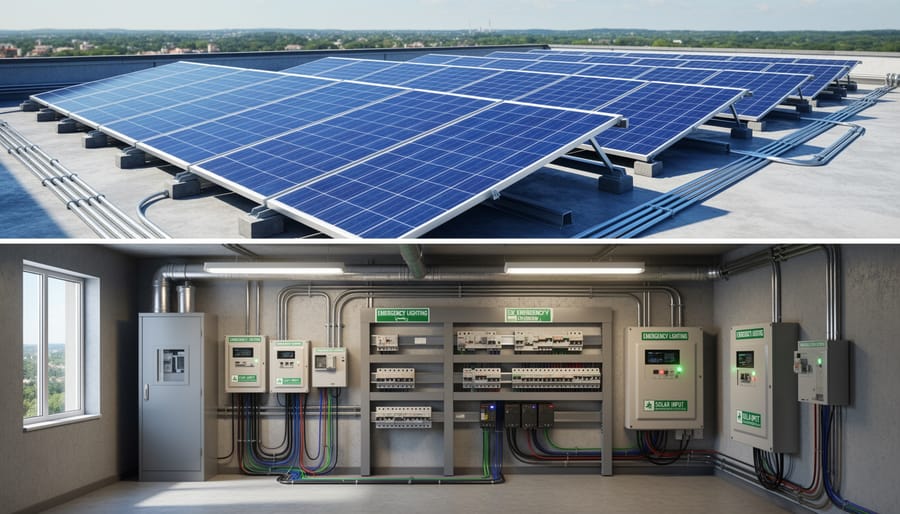
Article 700 addresses the emergency systems that building codes legally require you to install, and understanding its scope helps you know exactly where compliant lighting must go. This article applies when your local building code mandates emergency power for life safety, covering three critical areas: egress routes (hallways, stairwells, and corridors people use to exit), illuminated exit signs, and any other lights designated as necessary for safe evacuation.
The code establishes firm performance standards. Your emergency lighting must activate immediately when normal power fails and continue operating for at least 90 minutes, giving occupants ample time to evacuate safely. You’ll also need to design the system so that no space falls into total darkness if a single light source fails, which typically means spacing fixtures to provide overlapping coverage.
Testing requirements matter just as much as installation. Article 700 requires you to provide a means for testing your emergency lighting under maximum anticipated load conditions, ensuring the system will perform when it’s needed most. For solar systems, this means demonstrating that your batteries can sustain the full lighting load for the required duration, a test your electrical inspector will expect you to conduct during final approval.
Article 701: Emergency Support Systems
Article 701 addresses emergency support systems, infrastructure designed to aid first responders and recovery teams during and after emergencies. Unlike Article 700’s legally mandated life-safety systems, Article 701 covers equipment that supports emergency personnel once they’ve arrived on scene.
Think of these as the systems that help firefighters, medical teams, or maintenance crews do their jobs effectively during a crisis. Common examples include emergency generator-powered ventilation systems that clear smoke from stairwells, specialized lighting in mechanical rooms where responders might need to shut down equipment, or backup power for communication systems that coordinate emergency response.
Article 701 systems typically appear in larger commercial buildings, hospitals, manufacturing facilities, and government buildings where emergency response operations might be complex. A warehouse might have Article 701 lighting illuminating sprinkler control valves and electrical panels that firefighters need to access quickly. An office tower might include powered exhaust fans that ventilate enclosed elevator lobbies during evacuations.
The key distinction: Article 700 keeps occupants safe as they exit; Article 701 helps professionals manage the emergency itself. Both can be powered by compliant solar emergency systems, though Article 700’s requirements are generally more stringent since they directly protect evacuating occupants.
Core NEC Requirements Every Solar Emergency System Must Meet
The 90-Minute Rule and Battery Backup
NEC Article 700 mandates that emergency lighting must continue functioning for a minimum of 90 minutes after normal power fails. This duration isn’t arbitrary, it represents the time needed for building occupants to evacuate safely and for emergency responders to complete initial operations. For solar emergency lighting systems, meeting this requirement comes down to proper battery sizing.
Your battery bank must store enough energy to power all connected emergency lights at full brightness for the entire 90-minute period. Start by calculating total wattage: if you have four 10-watt LED exit signs, that’s 40 watts running continuously. Multiply by 1.5 hours (90 minutes) to get 60 watt-hours of minimum capacity. Then add a safety margin of at least 20 percent to account for battery aging and temperature variations, bringing you to roughly 72 watt-hours for this example.
Battery chemistry matters too. Lithium iron phosphate batteries maintain consistent voltage throughout discharge, while sealed lead-acid batteries experience voltage drop. Both can meet the 90-minute rule when properly sized, but lithium options typically require less physical space. Whatever you choose, your system documentation should clearly demonstrate how battery capacity exceeds the 90-minute requirement before any inspector requests it.
Redundancy and No-Total-Darkness Standards
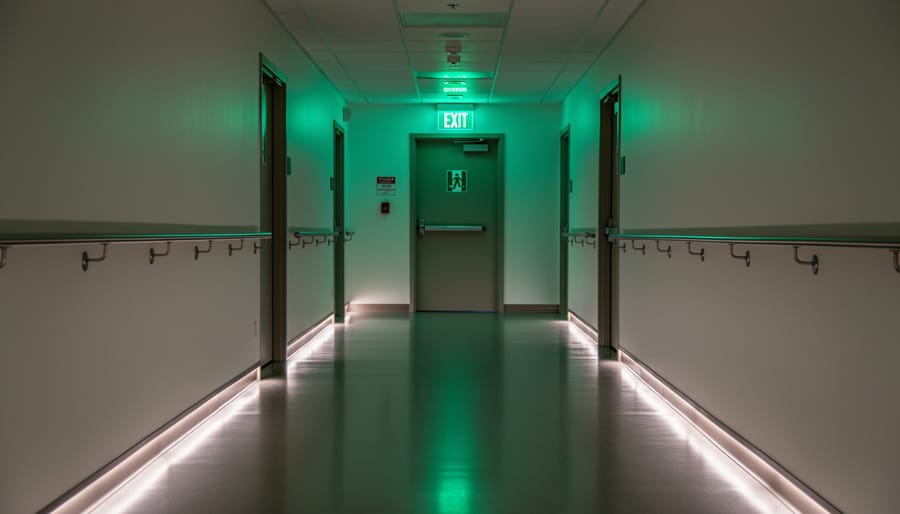
NEC emergency lighting systems must ensure that a single fixture failure never leaves a space completely dark. This critical redundancy requirement protects building occupants during emergencies, preventing disorientation and panic in exit routes and stairwells.
Solar emergency lighting naturally lends itself to distributed redundancy. Rather than relying on a central emergency battery system feeding multiple fixtures, each solar-powered unit typically contains its own battery and panel. This inherent decentralization means one fixture’s failure won’t affect others, automatically satisfying the no-total-darkness standard.
When designing your system, position fixtures so their coverage areas overlap slightly. For hallways, place units on alternating sides rather than in a single line down the center. In stairwells, install fixtures at each landing instead of every other floor. This strategic spacing ensures that even if one unit fails completely, adequate illumination remains throughout the egress path.
Document your coverage plan with lux measurements or photometric layouts showing the illumination levels that persist if any single fixture goes dark. Inspectors appreciate seeing this forethought, and it demonstrates your commitment to genuine safety rather than bare-minimum code compliance.
Testing Requirements Under Maximum Load
The NEC doesn’t just require that emergency lighting systems function, it mandates that you test them under the worst-case scenario they’ll actually face. Section 700.4(A) specifies that you must provide means for testing all emergency lighting and power systems during maximum anticipated load conditions. This ensures that when every emergency light in your facility activates simultaneously during an actual power failure, the system won’t collapse under the demand.
For solar emergency lighting, this requirement shapes your design from the start. Your battery bank must support every connected fixture running at once, not just theoretical calculations on paper. During installation and periodic inspections, you’ll need to simultaneously activate all emergency lights connected to each solar system and verify they maintain required illumination levels for the full 90-minute duration. This means incorporating test switches or controls that can trigger a full-load simulation without waiting for an actual power outage.
Many solar emergency lighting systems now include built-in test modes that disconnect from normal power while activating all connected fixtures, making compliance straightforward. Document each test with date, duration, and performance results, electrical inspectors expect this maintenance record, and it demonstrates your system meets code requirements when they matter most.
Why Solar Emergency Lighting Makes Sense for Code Compliance
Solar emergency lighting systems align remarkably well with NEC code requirements because they inherently address the core concerns the regulations were designed to solve. When you look at what the code actually demands, reliable backup power, independence from single points of failure, and verifiable performance, solar systems check every box without the compromises traditional grid-tied emergency lighting requires.
The most obvious advantage is grid independence. When normal power fails, solar emergency lighting operates completely separately from the electrical disruption affecting the building. Your emergency exit signs and egress lighting aren’t waiting for a transfer switch to engage or relying on utility power restoration. The system was already running independently, which means instantaneous response to outages. This inherent isolation satisfies the NEC’s fundamental expectation that emergency systems remain operational when everything else goes dark.
Retrofit installations particularly benefit from solar approaches. Running new conduit and branch circuits to connect traditional emergency lighting back to a central battery bank or generator often means opening walls, navigating existing infrastructure, and coordinating with occupied spaces. Solar emergency fixtures can be positioned exactly where code requires illumination without tracing wire paths back through the building. You’re still meeting the same NEC Article 700 requirements for egress lighting and exit signs, but the installation itself becomes simpler in buildings where adding conventional emergency circuits would be disruptive or prohibitively complex.
The redundancy requirements under NEC, specifically that no space can be left in total darkness if a single source fails, work naturally with distributed solar systems. Each fixture operates independently with its own battery backup, so a failure in one location doesn’t cascade through the system. You’re creating multiple independent points of compliance rather than depending on a single centralized emergency power source.
From a sustainability standpoint, meeting life-safety code requirements and environmental responsibility don’t have to conflict. Solar emergency lighting fulfills your legal obligations under Articles 700 and 701 while reducing the ongoing energy consumption and environmental footprint of maintaining code compliance. That alignment matters to property managers balancing regulatory requirements with organizational sustainability commitments.
Designing Your Solar Emergency Lighting System for NEC Compliance
Calculating Battery Capacity and Solar Panel Size
Start by calculating your total emergency lighting load. List every exit sign and fixture that must operate during an outage, then add up their wattage. A typical LED exit sign draws 5 watts, while emergency-rated LED fixtures range from 8 to 15 watts each. Multiply your total wattage by 1.5 hours (the 90-minute requirement) to get watt-hours needed.
Here’s where the safety margin matters: don’t size your battery bank for exactly 90 minutes. Real-world conditions, partial cloud cover reducing solar charge, battery aging, cold temperatures affecting capacity, all reduce available power. A practical approach is to size your battery system for 120 to 150 minutes of runtime. If your calculation shows you need 300 watt-hours for 90 minutes, spec a battery bank with 400 to 500 watt-hours of usable capacity.
For solar panel sizing, you’re charging batteries that must be ready for the next outage. Calculate your daily energy consumption by multiplying total wattage by expected daily runtime (typically minimal for emergency lights on standby). Then factor in your location’s average sun hours and charge controller efficiency. In regions with four peak sun hours daily, a 50-watt panel can reliably maintain a battery bank supporting 200 watt-hours of emergency load.
Include charge controller capacity in your planning, it must handle your panel’s maximum output while properly managing battery charging cycles. Most quality charge controllers provide temperature compensation and multi-stage charging, which extends battery life and ensures full capacity when you need it.
Installing Required Surge Protection Devices
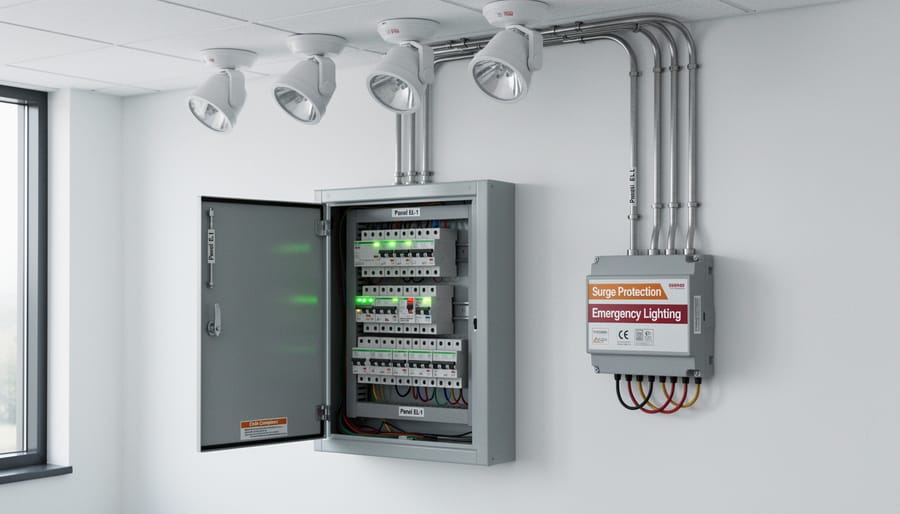
The 2014 NEC introduced a critical protection requirement through Section 700.8: all emergency systems switchboards and panelboards must now include a listed surge protective device. This mandate recognizes that power surges from lightning strikes, grid switching, or equipment failures can disable emergency lighting precisely when it’s needed most.
For solar emergency systems, incorporating SPDs is straightforward but essential. The device must be listed (meaning it’s been tested and certified by a recognized testing laboratory) and installed between your solar charge controller and the battery bank. Most modern solar charge controllers have built-in surge protection, but they don’t always meet the NEC’s listing requirement for emergency systems. You’ll need a separate, listed SPD rated for your system’s DC voltage.
Position the SPD as close as possible to the equipment it’s protecting. In a typical solar emergency lighting setup, install it directly after the charge controller and before the battery input. Use properly sized conductors and ensure solid grounding connections, since the SPD diverts surge energy to ground. Keep the ground wire as short and straight as possible for effective surge dissipation.
Document the SPD’s listing information for inspection. Inspectors will verify that the device carries an appropriate certification mark and matches your system’s specifications. This small addition protects your investment and ensures your emergency lighting remains operational when occupants depend on it.
Step-by-Step Installation Tutorial for a Compliant Solar Emergency Exit Sign
Installing a solar emergency exit sign might seem daunting, but the process is straightforward when you follow code requirements from the start. This tutorial walks through a typical installation for an LED exit sign with integrated solar panel and battery backup that meets NEC Article 700 standards.
Before you begin, verify your exit sign is listed for emergency use and includes the required 90-minute battery capacity. You’ll also need a listed surge protective device as mandated by NEC Section 700.8, basic hand tools, a voltage tester, and appropriate wire connectors.
- Turn off power at the breaker and verify it’s off using your voltage tester at the installation location. Even though solar units can operate independently, many integrate with building circuits for testing purposes.
- Mount the exit sign housing at the required height above the door, ensuring it’s visible from the egress path. Most codes require exit signs at a minimum of 6 feet 8 inches from the floor to the bottom of the sign.
- Connect the solar panel leads to the charge controller input terminals inside the housing. The panel should face a window or skylight where it receives adequate daily light, even indirect daylight works for modern panels, though direct sun charges faster.
- Wire the battery pack to the charge controller output, observing proper polarity. The battery provides your 90-minute emergency duration, so double-check all connections are secure and won’t vibrate loose over time.
- Install the required surge protective device according to manufacturer instructions. This typically connects between the solar charging circuit and the battery to protect against voltage spikes.
- Connect the LED exit sign to the battery output terminals. Most modern units draw minimal power, often under 5 watts, which is why solar charging is so effective for this application.
- Configure the test switch that simulates power loss. NEC requires the ability to test emergency systems under maximum load, and this switch lets inspectors verify your 90-minute duration without waiting for an actual outage.
- Document the installation date, battery capacity, and expected replacement schedule on the sign or in your facility records. Inspectors appreciate clear maintenance documentation.
After installation, run a full 90-minute discharge test while monitoring the illumination level. The sign should maintain clearly visible lettering throughout the entire test period. Mark your calendar for monthly brief tests and an annual full-duration test to maintain compliance. Keep a simple log noting test dates and results, it demonstrates due diligence during inspections and helps you catch battery degradation before it becomes a code violation.
Real-World Success: Property Managers Share Their Solar Emergency Lighting Experiences
Maria Chen manages a three-story office complex in Portland and decided to retrofit solar emergency exit signs in her parking garage. “I was nervous about the inspection,” she admits, “but our electrical contractor walked the inspector through the battery sizing calculations and surge protection setup. Everything passed on the first try. What surprised me most was how much simpler the installation was compared to running new conduit from the main panel.”
Tom Bradford oversees facilities for a nonprofit community center that upgraded to solar emergency lighting after their old battery packs failed inspection. “We were looking at trenching through landscaping to add emergency circuits,” he explains. “Solar let us meet the 90-minute requirement without tearing up our grounds. Our inspector actually commented on how clean the installation looked. Two years in, we’ve had zero maintenance issues beyond the quarterly testing we’re required to do anyway.”
Jennifer Park operates a small warehouse facility and initially questioned whether solar could handle the load requirements. “I was skeptical until our contractor showed me the battery capacity math,” she says. “During our required load testing, the lights stayed on well past the 90-minute mark. The inspector tested them twice just to be sure, and both times they performed flawlessly.”
These managers consistently emphasize two points: work with contractors who understand NEC requirements, and document everything for your inspector. The technology works when properly designed, and building departments increasingly recognize solar emergency lighting as a legitimate compliance path.
Common Questions About NEC Compliance and Solar Emergency Systems
When you’re considering solar emergency lighting for the first time, you probably have questions about how inspectors view these systems and what you’ll need to maintain them. Here are answers to the most common concerns property managers and facility operators face.
Will electrical inspectors approve solar emergency lighting systems?
Yes, as long as your system meets the same NEC requirements as grid-powered emergency lighting: 90-minute battery duration, proper redundancy to prevent total darkness, listed surge protective devices, and testing capability under maximum load. Inspectors evaluate the system’s compliance, not its power source.
Can I retrofit existing emergency lighting with solar instead of replacing the entire system?
Absolutely. Solar emergency lighting works especially well in retrofit situations because you avoid running new electrical conduit from the main panel. You’ll still need to meet all NEC Article 700 requirements, including the SPD mandate added in the 2014 edition, but the installation is often simpler than grid-tied options.
What maintenance does a solar emergency lighting system require?
Plan to test the system monthly under load conditions as NEC requires, clean solar panels quarterly to maintain charging efficiency, and inspect battery health annually. Most solar batteries need replacement every few years depending on depth of discharge and ambient temperature.
Do I need to involve a licensed electrician for installation?
Yes. Even though solar systems are DC-powered, emergency lighting installation requires proper code knowledge and compliance documentation. A licensed electrician ensures your system meets all NEC requirements and can coordinate with inspectors during the approval process.
The key to smooth approval is documentation. Keep records of your battery capacity calculations showing the 90-minute duration requirement plus your safety margin, the specifications for your listed surge protective device, and your testing protocol. When inspectors see you’ve addressed each NEC requirement systematically, they’re much more likely to sign off quickly.
One concern that comes up frequently: what happens during extended cloudy periods? Size your battery bank to handle several discharge cycles, and position your panels to maximize available light even in overcast conditions. Your electrician can help you calculate appropriate capacity based on your local climate patterns and the critical nature of your emergency lighting.
Meeting NEC emergency lighting requirements doesn’t mean choosing between compliance and sustainability. Solar emergency systems deliver both: they satisfy the stringent standards of Articles 700 and 701 while reducing your facility’s environmental footprint and operational complexity. You’ve seen how properly sized battery storage meets the 90-minute duration requirement, how thoughtful fixture placement ensures redundancy, and how incorporating listed surge protection devices keeps your system within code. The property managers who shared their experiences proved that inspectors welcome well-designed solar installations when they clearly address each NEC mandate.
Your next steps are straightforward. Review your facility’s emergency lighting needs against the requirements we’ve covered. Sketch out fixture locations that prevent total darkness if any single source fails. Calculate your battery capacity with a safety margin beyond 90 minutes. Then work with a qualified installer who understands both solar systems and emergency lighting code, or tackle the installation yourself using the tutorial as your guide. When you document your testing procedures and demonstrate compliance during inspection, you’ll join the growing number of facilities running code-compliant emergency systems that never draw a watt from the grid.